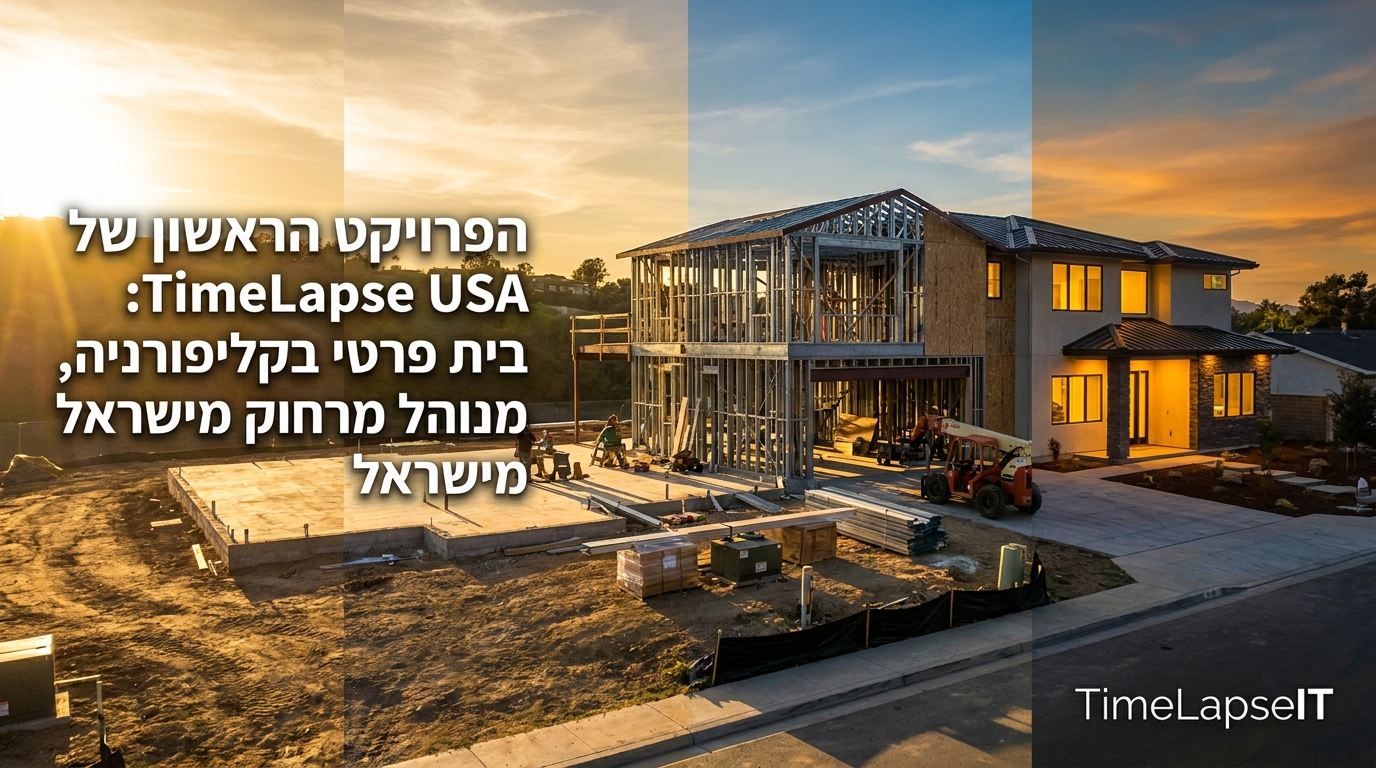
Some projects document a building. This one also builds a new way of working. A private house in Southern California is the first project of TimeLapse USA — and the moment our operation moved from local documentation to international service.
The site is in the Los Angeles area. We are in Israel. Despite the distance, we manage the filming, store the footage and run the entire production process — remotely.
How remote time-lapse works
The model is simple, but it demands precise planning. The client purchases the camera system in the United States, installs it on-site following our guidance, and connects it to the network. From that point we take over: monitoring the camera, adjusting settings, backing up every frame and producing the films.
Until this project, most of our work happened in Israel — we knew the sites, came for installations, handled the equipment ourselves. California forced us to think differently. We couldn’t drive over to fix an angle or change a setting, so every early decision — camera model, site conditions, shooting position — carried extra weight.
What it proves
Our systems are autonomous: solar-ready, cellular-connected, managed from anywhere. If we can document a build near Los Angeles from Tel Aviv, we can document your site wherever it is. That’s the promise behind our construction time-lapse services — now proven on two continents.